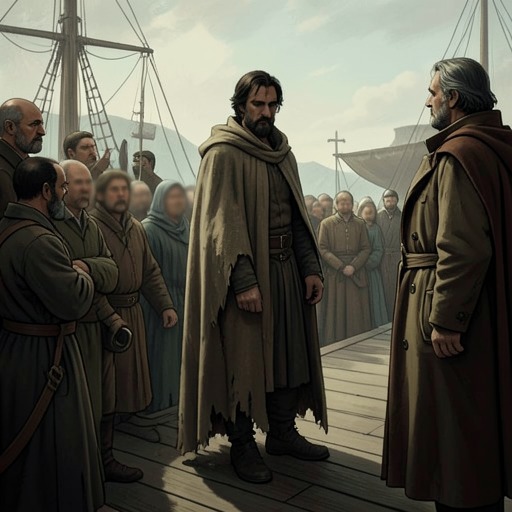
the Courtier's Avenger
The Man Who LaughsThe Courtier's Avenger, known as Barkilphedro, moves from failed religious ambition into the overlapping surveillance networks of Duchess Josiana, Lord David Dirry-Moir, and Queen Anne. His rise depends less on formal authority than on being trusted to gather information—and on his capacity to wait for circumstances he can turn to advantage.
Background and Failed Ambition
Barkilphedro had served the Duke of York before attempting a career in the church. The Duke, who maintained both Catholic and Protestant households, might have advanced him in either religious hierarchy, but judged him insufficiently Catholic for the position of almoner and insufficiently Protestant for that of chaplain. Rejected by both paths, Barkilphedro was left between two religious establishments without a place in either.
The narration presents this failure as formative to his social position. It describes him as having been left low, and suggests that certain ways of advancing are possible only through crawling. The image anticipates his later service: he gains access not through a public office of spiritual authority, but by making himself useful within the private rivalries of powerful people.
A Trusted Observer Between Rivals
Duchess Josiana employed Barkilphedro to keep Lord David under discreet observation. Lord David, in turn, used the same man to watch Josiana. Queen Anne also relied on him to remain informed about both Josiana and Lord David, her future brother-in-law. Barkilphedro thus served three patrons whose interests and suspicions overlapped, becoming a channel through which each could monitor the others.
The arrangement gives him an unusual position: he is trusted by a queen and by two aristocratic figures who are watching one another. The narration characterizes him as a man positioned between women, while also emphasizing the competing relationships and interests concentrated in his hands. His influence rests on access to information, but that access is dependent on the confidence of those he observes and serves.
Appointment at the Admiralty
Barkilphedro sought the post of jetsam officer. The Admiralty divided its work concerning objects cast away at sea into three offices: lagan dealt with items sunk to the bottom, flotsam with those that remained afloat, and jetsam with those thrown ashore. A ship in distress or otherwise wishing to send information to land could place a written notice in a sealed bottle and cast it into the sea; the bottle's eventual fate determined which office handled it.
A week after the position was promised, Josiana's efforts and Lord David Dirry-Moir's influence secured Barkilphedro's installation at the Admiralty. The post ended his precarious existence: he received lodging and board as well as a salary of one hundred guineas. His appointment therefore joined practical security to the patronage network he had already served, giving him an official place connected with information arriving from the sea.
Patience and the Pursuit of Josiana's Weakness
Barkilphedro's stated determination is to find Josiana's vulnerable point and strike there. The narrative distinguishes his method from the careful staging of an ordinary crime. Rather than prepare one fixed scheme, he waits, equips himself to use whatever circumstances arise, and avoids committing himself to a plan that unforeseen events might render useless.
This patience is presented as a form of predatory opportunism. Barkilphedro watches for chance and seeks to turn an unexpected circumstance rapidly to his own advantage. The available account establishes his intention and method, but does not specify the particular opportunity he will seize or the outcome of his effort against Josiana. His role is therefore marked by suspended action: he has chosen his target, while the occasion for acting remains to be found.